How to Use AI Tools Safely: A Complete Privacy & Security Guide

Introduction: Are AI Tools Safe to Use?
Artificial Intelligence (AI) tools are transforming how we write, design, code, analyze data, and run businesses. But as their popularity grows, so do concerns about privacy, security, and responsible usage.
Are AI tools safe? The honest answer is: they can be — if you use them correctly.
Like any powerful technology, AI software comes with risks. These risks don’t mean you should avoid AI altogether. Instead, they mean you should understand how it works, what data it processes, and how to protect yourself.
This guide will walk you through the real risks, common misconceptions, and practical steps you can take to use AI safely — whether you're a student, freelancer, developer, or business owner.
1. Understanding What AI Tools Do With Your Data
Most modern AI tools rely on machine learning models trained on large datasets. When you interact with them, your input — often called a prompt — is processed to generate a response.
Depending on the platform, your data may be:
- Temporarily stored to generate responses
- Logged for quality improvement
- Used in anonymized model refinement
- Encrypted in transit
Reputable AI platforms clearly outline their data policies. Always check:
- Privacy policy
- Data retention period
- Whether prompts are used for training
- Enterprise data protection options
Enterprise versions of AI tools often include stricter privacy controls, meaning your data is not used for further training.
2. The Biggest AI Safety Risks You Should Know

Data Leakage
Uploading sensitive information — such as financial records, legal documents, medical data, or proprietary code — can create exposure risks if the platform does not guarantee strict isolation.
Hallucinations
AI models can generate confident but incorrect answers. This is especially risky in legal, medical, academic, or financial contexts. Always verify important information.
Prompt Injection
In more advanced AI systems, malicious inputs can manipulate model behavior. While this is more relevant to developers building AI-powered apps, it’s important to understand.
Over-Reliance on Automation
AI should assist decision-making — not replace critical thinking. Blindly trusting outputs can lead to errors.
3. What You Should Never Upload to AI Tools
As a general rule, avoid uploading:
- Social security numbers or government IDs
- Banking details
- Confidential contracts
- Private medical records
- Unreleased proprietary business information
- Passwords or API keys
If you must work with sensitive data, use enterprise AI solutions with explicit data processing agreements.
4. How to Protect Yourself While Using AI
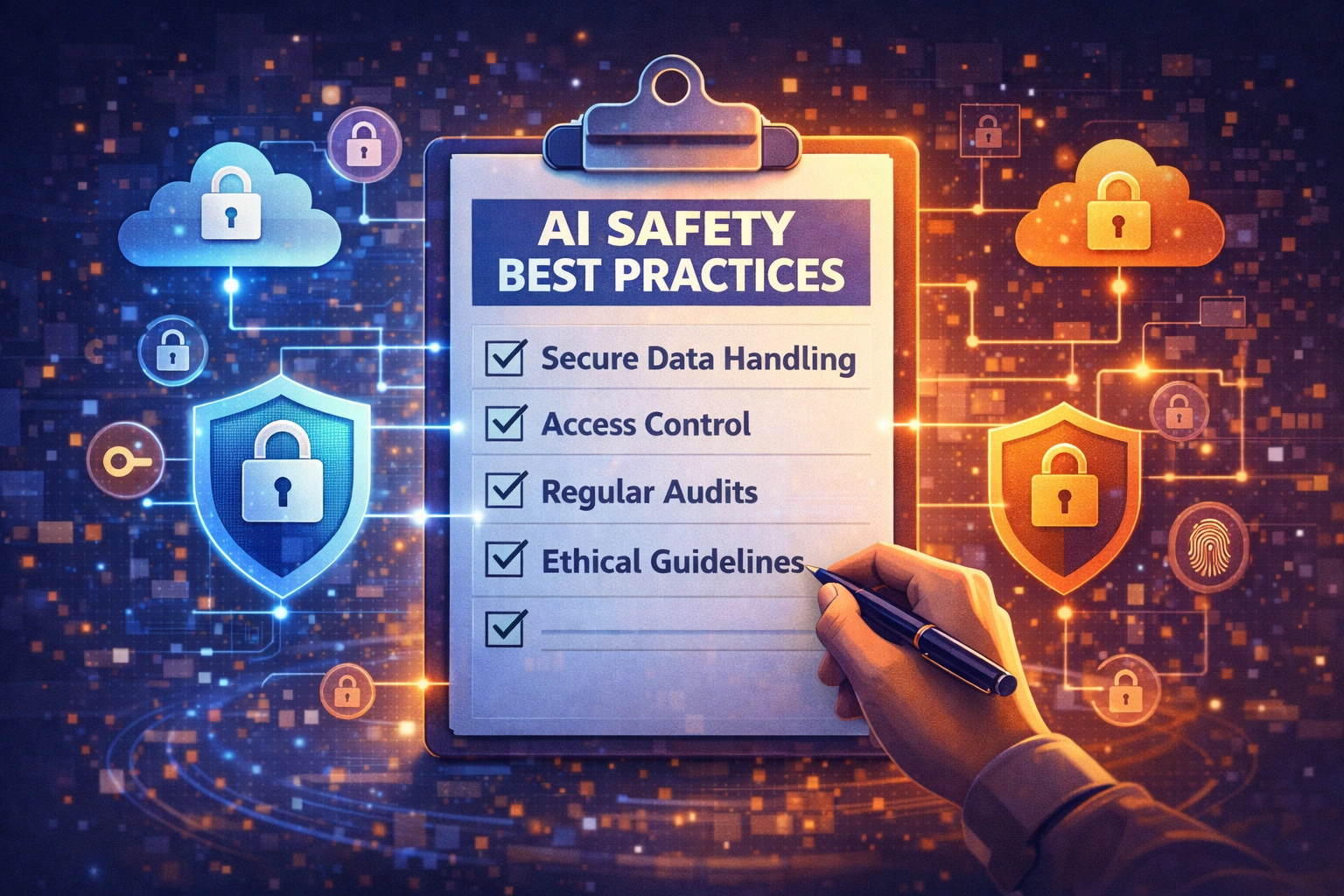
Use Strong Account Security
- Enable two-factor authentication
- Use unique passwords
- Avoid sharing accounts
Review Privacy Policies
Before using any AI tool professionally, read the privacy terms. Look for encryption practices and retention policies.
Verify Important Outputs
Especially in research, finance, health, or compliance scenarios.
Limit Data Sharing
Use placeholders or anonymized data whenever possible.
Stay Updated
AI regulations and policies evolve quickly. Stay informed about new standards and guidelines.
5. AI Safety for Businesses and Teams
If you run a business, AI safety becomes even more critical.
Best practices include:
- Creating internal AI usage policies
- Restricting which tools employees can use
- Using enterprise-grade AI platforms
- Training staff on AI literacy
Many companies now treat AI access similarly to cloud software access — governed, monitored, and documented.
6. AI Regulations and the Future of Responsible Use

Governments worldwide are developing AI regulations focused on transparency, accountability, and data protection.
We are seeing increased emphasis on:
- Alignment
- Bias mitigation
- Transparency requirements
- Red teaming
- Security audits
The future of AI isn’t unregulated chaos. It’s structured innovation with safeguards.
7. Final Checklist: Safe AI Usage Summary
Before using any AI tool, ask yourself:
- Am I sharing sensitive information?
- Have I read the privacy policy?
- Am I verifying critical outputs?
- Is this tool appropriate for my task?
AI tools are not inherently dangerous — but careless usage can be.
The safest approach is informed usage. Learn the basics. Understand the risks. Take simple precautions.
When used responsibly, AI can dramatically increase productivity, creativity, and efficiency — without compromising your privacy.
The key isn’t avoiding AI.
It’s using it wisely.